
Step Away from the Screen
Divesting from the Outrage Economy.

Hey you.
Yea. You.
I want you to make me a promise before you continue reading. Can you do that for me?
Good.
When you get to the end of this piece, don’t worry about liking, commenting, sharing, or subscribing.
Instead, take five minutes to step away from the screen.
It’s not that I don’t want your digital validation; I’m desperate for it.
It’s just that I’ve been radicalized.
Tangle’s Isaac Saul published a paywalled piece entitled “It’s Time to Embrace the Tech Backlash.”
If you aren’t already making Tangle a healthy part of your news diet, I recommend it highly as a first step towards divesting from the Outrage Economy.
In Isaac’s manifesto, he describes a brewing revolution. Considering Tangle’s ethos of turning down the temperature on American political discourse, I was struck by Isaac’s use of revolutionary language.
“It is a resistance and a genuine dread of just how much time we are all spending in front of our screens.”
Perhaps what he is describing is more of a counter-revolution. Since the Age of Industry, we’ve seen upheaval after upheaval, from the printing press to 24 hour cable news to the all engrossing twittersphere.
And some people, not all but a growing number, are getting sick of it. It’s obvious to anyone who’s paying attention that technology has been leveraged as much to create an addictive profit machine as it has to enhance the human experience. Under the guise of connecting and informing us, a wedge of fear and rage has been thrust into our midst. We’ve learned to hate perfect strangers for their thoughts and opinions just a few short years after being told we should accept those who looked and loved differently from us.
Sure, technological leaps have cured plenty of diseases and lifted many out of poverty. But does a longer life translate to a better one? It might. Or it might not. Satisfaction will mostly be up to the users and their surroundings. And considering we’re little more than tool-wielding apes that have had written language for about five percent of our existence, forgive me if I’m doubtful about our odds.
I love my iPhone and my MacBook as much as the next guy; they’ve kept me in touch with dozens of people who otherwise would’ve faded beyond memory. Technology has given me access to ideas and inspiration that my grandparents couldn’t dream of.
But we’ve also used our super tools to photoshop lies into the public discourse, misrepresent quotes and facts to the masses, and now thanks to AI, we’re encroaching upon and era where anything can be easily deepfaked.
Why should I believe anything I see on the internet again?
We haven’t entirely degraded the common ground of an objective reality - if we ever truly had one - but we’re not far from it. There are and will be plenty of trusted sources like Tangle on the internet, but if we’re not careful, they’ll be relegated to needle in a haystack status.
So, like Isaac suggested, why not turn to our old school sources when we can? Call your mom to ask what the good ole days were like. Text an old mentor for expertise before outsourcing it to the Machine.
Their memories might be just as corrupted as the Wikipedia articles ChatGPT is scraping from, but at least you’ve made human contact. At least you’ve shared something more important than information: you’ve shared a moment. You’ve strengthened a bond.
Go outside and “touch grass” as the kids these days are saying. Strike up a conversation with a stranger about the weather. Invite your politically opposite uncle over for dinner and a chat. Bump up against some strangers at a local watering hole.
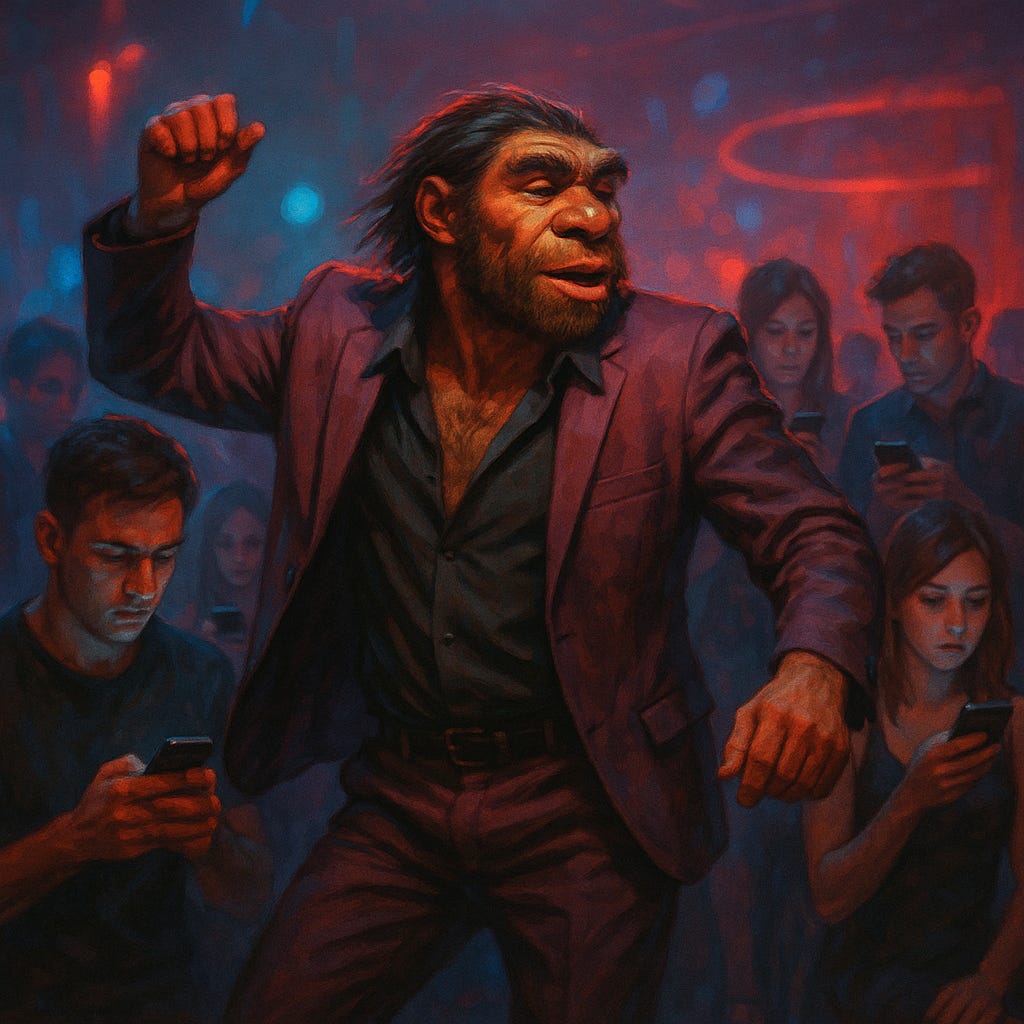
As Kurt Vonnegut once wrote, we’re dancing animals. So, whatever you do, don’t forget to step away from the screen.
Also,
Thanks.